Jaguar F-TYPE Project 7: The Modern Jaguar That Was Never Supposed to Exist
Born from a sketch, inspired by Le Mans and limited to just 250 cars worldwide, the Jaguar F-TYPE Project 7 became one of the rarest and most charismatic modern Jaguars ever produced.
There are plenty of fast Jaguars. There are considerably fewer Jaguars that become instant collector cars.
The F-TYPE Project 7 is one of them.
Built in extremely limited numbers, hand-assembled by Jaguar Land Rover’s Special Vehicle Operations division and styled as a modern interpretation of the legendary Jaguar D-Type, Project 7 was never intended to be an ordinary member of the F-TYPE family. It was a passion project that somehow escaped the design studio and made it onto the road.
And perhaps the most remarkable part of its story is that the whole thing began with a sketch.
From a Designer’s Sketch to a Jaguar Icon
The story of Project 7 began in 2013 when Jaguar designer César Pieri produced an experimental sketch based around the recently launched F-TYPE.
The idea was deliberately extreme: take Jaguar’s new sports car and reinterpret it as a modern racing roadster, drawing heavily on the company’s motorsport heritage.
Jaguar’s Director of Design, Ian Callum, immediately saw something special in the drawing.
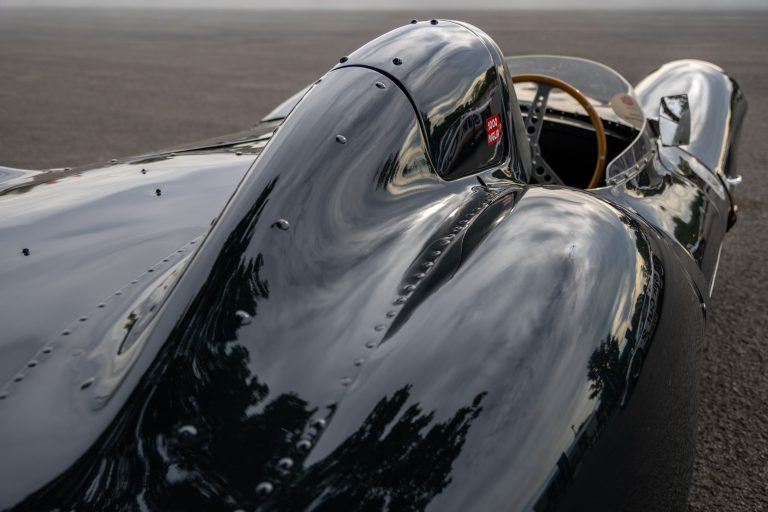
The concept featured a dramatically shortened windscreen, a single-seat cockpit, a large aerodynamic fairing behind the driver and styling inspired by the D-Type — the legendary Jaguar that won the Le Mans 24 Hours three consecutive times in 1955, 1956 and 1957.
According to Jaguar, the project progressed from Pieri’s initial sketch to a functioning car in just four months.
That speed of development tells you almost everything about Project 7. This wasn’t a conventional new model programme involving years of planning, huge production targets and extensive market research.
It was a project driven by enthusiasm.
Jaguar’s designers wanted to see what they could create.
And they created something spectacular.
The name Project 7 was chosen to celebrate Jaguar’s seven outright victories at Le Mans — in 1951, 1953, 1955, 1956, 1957, 1988 and 1990.
The blue paintwork of the original concept also deliberately evoked Jaguar’s racing colours and the famous D-Types of the 1950s.
The Concept That Was Too Good to Ignore
Project 7 made its public debut at the 2013 Goodwood Festival of Speed.
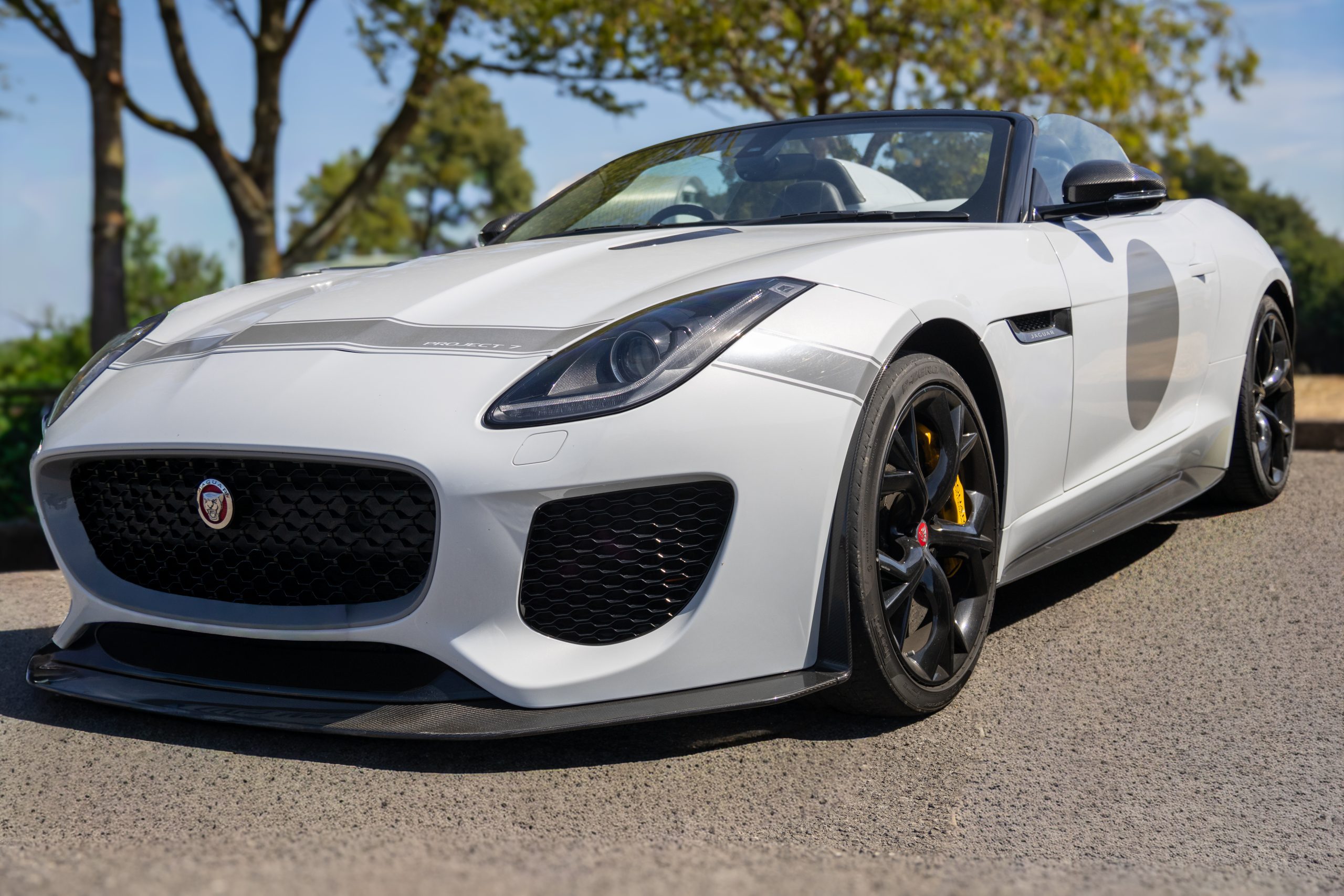
The concept was an outrageous machine. It had a single driver’s seat, an open cockpit, a low-cut windscreen, carbon-fibre aerodynamic components and the unmistakable D-Type-inspired rear fairing.
Underneath was an F-TYPE aluminium structure and Jaguar’s supercharged 5.0-litre V8, producing 550 horsepower in concept form.
It wasn’t merely a static design exercise. Jaguar actually built the car to be driven.
That mattered.
Once the public saw it — and once Jaguar saw the reaction — the idea of Project 7 remaining a one-off became increasingly difficult to justify.
Interest was enormous.
But turning the concept into a production car was far from straightforward.
In 2013 the F-TYPE was still a relatively new model. The range consisted of the convertible, available with V6 and V8 engines, and Jaguar was effectively being asked to create its most extreme version almost at the very beginning of the car’s life.
Normally, limited-run halo cars arrive towards the end of a model’s production cycle, when manufacturers can use an increasingly familiar platform to create one final, spectacular version.
Project 7 was different.
It had to be engineered, approved and put into production extremely quickly, with the target of having a production-ready car at Goodwood the following year.
The transformation from concept to production car did require some compromises. The single-seat arrangement disappeared and was replaced with two seats, while a removable Bimini-style roof was developed to give the production car some protection from the weather.
But remarkably little of the concept’s character was lost.
The Road to Special Vehicle Operations
Project 7’s development also coincided with an important change within Jaguar Land Rover.
At the time, the company already had an internal Engineer to Order operation carrying out specialist projects. What it lacked was a highly visible, outward-facing division comparable with Mercedes-AMG or BMW M.
The thinking was that the existing specialist capability could be developed into something much more ambitious — a division capable of producing not only high-performance cars, but also bespoke and limited-run vehicles.
That idea eventually became the Individual Product Division, or IPD, before being renamed Special Vehicle Operations — SVO.
Project 7 therefore arrived at exactly the right moment.
It wasn’t simply the first extreme F-TYPE. It became one of the cars that demonstrated what the newly created operation could actually achieve.
The significance of that goes beyond the Project 7 itself. The philosophy established here — taking an existing Jaguar, pushing the engineering far beyond the standard range, producing it in tiny numbers and turning it into a halo product — would later be seen again in cars such as the XE SV Project 8.
Project 7 was the beginning.
From Concept to Production Reality
Once the decision was made to investigate production, Jaguar Land Rover needed to establish whether there was a viable market for such an expensive and technically demanding car.
Dealers were asked how many examples they believed they could sell. That information would help establish the potential price point and whether the considerable engineering investment could be justified.
The response suggested that there was a market for something far more extreme than the standard F-TYPE.
The target eventually became 250 cars worldwide.
That number would prove remarkably important.
Rather than building thousands of cars and creating an artificial limited edition, Jaguar was committing to a genuinely tiny production run from the outset.
The reaction at Goodwood in 2014 confirmed that the decision had been the right one. Selected customers were given the opportunity to experience the production car before the festival opened to the public, and interest quickly accelerated.
By the end of the event, the cars were effectively sold out, with a substantial waiting list of prospective buyers.
Project 7 had gone from an experimental sketch to a production reality — and demand had exceeded supply.
Engineering the Project 7
Rather than simply fitting a more powerful engine and adding some cosmetic changes, Jaguar’s engineers substantially reworked the F-TYPE.
One of the biggest challenges was weight reduction.
The Project 7 received Carbon Ceramic Matrix brakes as standard, lightweight body components, carbon-fibre elements, lightweight seats and a manual roof in place of the standard F-TYPE’s electrically operated folding roof.
The result was a weight saving of at least 80kg compared with the conventional V8 F-TYPE convertible.
That might not sound enormous in isolation, but removing that much weight from a car already carrying a supercharged V8 and substantial performance hardware made a significant difference to its character.
The car remained heavier than the engineers would ideally have liked, but the reduction was considerable.
The bespoke bodywork also created engineering challenges that weren’t immediately obvious from the finished car.
The dramatic rear fairing was central to the Project 7’s design identity, but the car had to be engineered for both left- and right-hand-drive markets.
The shortened windscreen was another major engineering challenge.
The production screen was approximately 114mm shorter than the standard F-TYPE’s windscreen, creating the distinctive low-slung appearance that became one of Project 7’s defining features.
The US market required further changes because American crash regulations would not permit the European specification’s combination of shortened windscreen and seating arrangement.
The result was effectively three versions of the car: right-hand-drive cars for markets such as the UK, left-hand-drive cars for Europe and a specific US specification.
This is a good example of just how far Project 7 had moved beyond being a simple styling exercise.
Behind the dramatic appearance was a considerable amount of bespoke engineering.
The Production Car
Project 7 became the first Jaguar performance vehicle created by Jaguar Land Rover’s newly established Special Vehicle Operations division.
Rather than simply fitting a few cosmetic options to an F-TYPE, the engineers substantially reworked the car.
The production Project 7 received:
- A supercharged 5.0-litre V8 producing 575PS
- 680Nm of torque
- Rear-wheel drive
- An eight-speed ZF Quickshift automatic transmission
- An electronic active differential
- Carbon Ceramic Matrix brakes
- Torque Vectoring by Braking
- Bespoke suspension tuning
- Carbon-fibre aerodynamic components
- Lightweight, race-inspired seats
- A fixed rear spoiler
- The distinctive D-Type-style rear fairing
- A bespoke removable roof
The aluminium-bodied car weighed approximately 1,585kg, around 80kg less than the F-TYPE V8 S Convertible on which it was based.
The result was a machine capable of 0–60mph in just 3.8 seconds, 0–100km/h in 3.9 seconds, and an electronically limited top speed of 186mph (300km/h).
At the time, Jaguar called it the fastest and most powerful production Jaguar it had ever built.
Only 250 Were Ever Made
This is where Project 7 becomes particularly interesting to collectors.
Jaguar originally announced that production would be capped at 250 cars worldwide.
Not 2,500.
Not 10,000.
250.
Every example was to be hand-built by Special Operations, and each car received a numbered plaque between the seats bearing Ian Callum’s signature.
The response was immediate. Jaguar reported that customer interest following the Goodwood reveal had far exceeded the intended maximum production run.
That is important because Project 7 was not a case of Jaguar struggling to sell an expensive special edition.
Quite the opposite.
Demand was greater than supply from the beginning.
The limited production number therefore wasn’t merely a marketing trick. There really was a tiny pool of cars available to the world’s Jaguar enthusiasts.
Production subsequently began in 2015, with the first customer cars emerging later that year.
Where Did the 250 Cars Go?
This is one of the most fascinating — and surprisingly difficult — questions surrounding Project 7.
Jaguar confirmed that the car was offered across a remarkably wide range of markets, including Europe, North America, Australia, South Africa, Russia, Brazil, the Middle East and Asia-Pacific.
However, Jaguar never appears to have published a definitive public country-by-country production register for all 250 cars.
That means claims that there are, for example, exactly “X” Project 7s currently surviving in a particular country should be treated with caution.
Cars have changed hands internationally for more than a decade. A Project 7 originally delivered to Britain could subsequently be exported to Europe, the Middle East or elsewhere. Likewise, a car originally delivered to the United States could later leave the country.
Consequently, the most accurate way to look at the worldwide distribution is through documented allocations and contemporary reports, rather than pretending there is a complete global survivor register.
Known and reported allocations
| Country / market | Known or reported number | Confidence |
|---|---|---|
| 🇬🇧 United Kingdom | 65 | High |
| 🇺🇸 United States | 50 | High |
| 🇨🇦 Canada | 7 | Very high |
| 🇦🇺 Australia | 10 | Strong contemporary evidence |
| 🇪🇺 Other European markets | Part of remaining production | Allocation not publicly documented in full |
| 🌍 Middle East / Africa / Asia-Pacific / other markets | Part of remaining production | Allocation not publicly documented in full |
The UK figure is particularly well documented. In July 2014, Autocar reported that all 65 cars allocated to the UK had already been sold, with another 100 people reportedly on the waiting list.
North America provides another useful piece of the puzzle.
Multiple sources report that 50 Project 7s were delivered to the United States, while Jaguar officially confirmed the model for the US market.
Canada is even better documented. Jaguar Land Rover Canada stated that its allocation was just seven cars — and claimed that all seven sold within seven seconds of being offered.
Australia appears to have received approximately 10 examples, according to Australian sales documentation describing the model’s local availability.
These figures alone account for approximately 132 cars, leaving roughly 118 examples distributed across other markets.
But that remaining number should not be interpreted as 118 cars currently residing outside these four countries. It represents the balance of the original worldwide allocation after these documented figures.
How Many Still Exist Today?
This is where the story becomes much harder.
The answer is: nobody outside Jaguar — and potentially nobody at Jaguar today without access to historical production and registration records — can reliably say how many of the 250 cars currently survive in each country.
There is no publicly available global Project 7 register that records every VIN, current owner and country of residence.
And that distinction is important.
If there were originally 65 cars delivered to the UK, that doesn’t necessarily mean 65 remain in Britain today. Some could have been exported. Some could be sitting in collections without being registered. Some may have been damaged or written off. Others may have changed hands several times.
The same applies to America, Canada and Australia.
Therefore, a responsible estimate should look something like this:
Confirmed worldwide production: 250 cars.
Confirmed/reported original UK allocation: approximately 65.
Reported US allocation: approximately 50.
Confirmed Canadian allocation: 7.
Reported Australian allocation: approximately 10.
Current surviving numbers by country: unknown.
That might sound less satisfying than producing a neat list of numbers, but it is considerably more accurate — and for collectors, that distinction matters enormously.
Why Project 7 Looks Like a D-Type
The D-Type connection isn’t simply a marketing exercise.
The most obvious feature is the enormous rear fairing behind the driver’s head.
On the original D-Type, the distinctive fin helped define the car’s aerodynamic character. On Project 7, Jaguar transformed that idea into a modern interpretation that became almost a piece of sculpture.
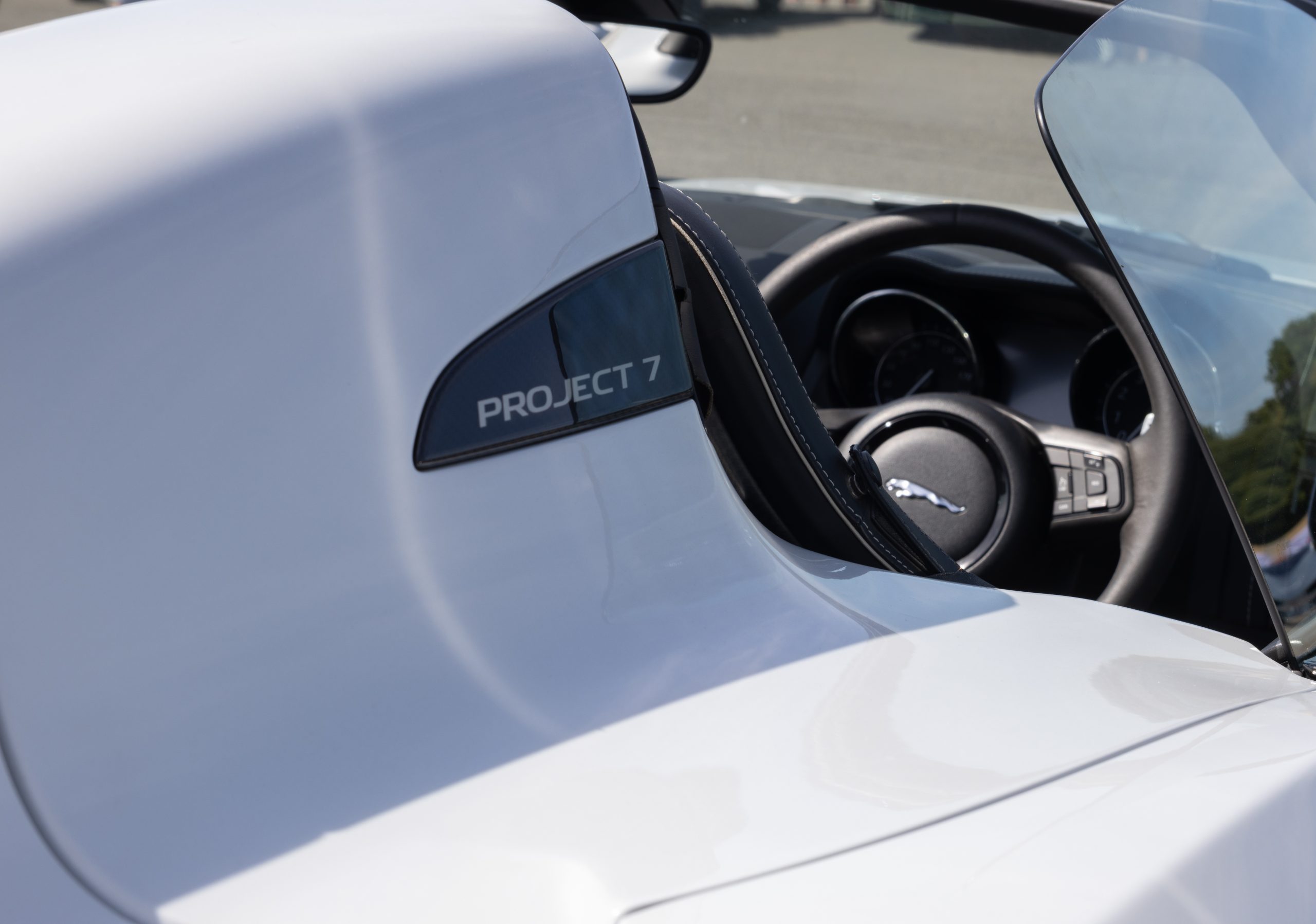
The result is one of the strangest-looking F-TYPEs ever produced.
It is simultaneously modern and historic.
From the front, it is unmistakably F-TYPE. From the side, however, the cut-down windscreen and sweeping rear bodywork make it look like a 21st-century interpretation of a 1950s Le Mans racer.
That was precisely the point.
Jaguar’s designers were not trying to recreate a D-Type. They were asking what a D-Type might look like if Jaguar had designed one using modern materials, modern engineering and the F-TYPE platform.
Jaguar itself described the brief as creating a modern-day D-Type.
The Seven
The number seven runs through the entire car’s identity.
Seven Le Mans victories.
Project 7.
Only 250 examples.
And a design that celebrates perhaps the most famous period of Jaguar’s racing history.
The seven Le Mans victories were achieved across four decades:
1951 — C-Type
1953 — C-Type
1955 — D-Type
1956 — D-Type
1957 — D-Type
1988 — XJR-9
1990 — XJR-12
The three consecutive D-Type victories of 1955–1957 are particularly significant because they provide the visual inspiration for Project 7.
In that respect, Project 7 wasn’t simply celebrating the F-TYPE.
It was celebrating Jaguar itself.
A Different Kind of Modern Classic
There is an interesting question surrounding Project 7 today.
Is it a supercar?
Technically, no.
It is an F-TYPE underneath.
But that description misses the point.
Project 7 was built during a period when Jaguar was beginning to rediscover how powerful its heritage could be. The F-TYPE had already revived the company’s two-seat sports-car identity, and Project 7 took that concept to an almost theatrical extreme.
It was lighter.
It was more powerful.
It was louder.
It was rarer.
And unlike a normal F-TYPE, it had the unmistakable appearance of something that had escaped from a Jaguar racing department.
The car also represented the beginning of a new era for Jaguar’s Special Vehicle Operations division.
Only a few years later, the same philosophy would produce the extraordinary XE SV Project 8, another hand-built, ultra-low-volume Jaguar designed to push the company’s performance engineering to an extreme.
Project 7 was the beginning.
Why the Project 7 Matters
There are faster modern Jaguars.
There are more technologically advanced Jaguars.
There are Jaguars that cost considerably more.
But very few have the combination of history, design, engineering and scarcity that makes Project 7 so interesting.
It represents a rare moment when a manufacturer’s designers were allowed to take an idea that started as a sketch and turn it into a production car with remarkably little dilution.
And the numbers make the point.
250 cars worldwide.
That means that, even before accounting for cars that may have been exported, damaged or placed into long-term collections, encountering a Project 7 is an unusually rare event.
The car’s rarity is also authentic. Jaguar didn’t manufacture thousands and then create an artificial “limited edition” story around the final few hundred.
It was conceived as a tiny production run from the outset, hand-built by Special Operations.
The Project 7 Legacy
More than a decade after its introduction, the F-TYPE Project 7 occupies an unusual place in Jaguar history.
It was born from a designer’s sketch.
It became a one-off concept.
Public reaction transformed it into a production possibility.
Special Vehicle Operations turned that possibility into reality.
And Jaguar eventually built just 250.
But the story is more remarkable when the circumstances surrounding its creation are considered.
This was an extreme car developed almost immediately after the launch of the F-TYPE, at a time when Jaguar Land Rover was simultaneously establishing a new specialist division capable of producing bespoke and limited-run vehicles.
The result was a car that wasn’t simply a more powerful F-TYPE.
It was a statement of intent.
It showed what Jaguar’s designers and engineers could achieve when they were given the freedom to take an existing car and push it far beyond the normal boundaries of a production model.
The Project 7 therefore tells a bigger story than simply being an unusually fast F-TYPE. It represents the point where Jaguar’s modern design language collided head-on with its racing heritage — and where the company briefly allowed its designers and engineers to build something simply because it was exciting.
That is perhaps why Project 7 remains so memorable.
The D-Type won Le Mans.
The F-TYPE brought Jaguar’s sports-car tradition into the modern era.
And Project 7 connected the two.
Only 250 people were ever given the opportunity to buy the result new.
For everybody else, the Project 7 became something rather more elusive:
a Jaguar that you don’t just see — you remember seeing.
Production at a glance
Model: Jaguar F-TYPE Project 7
Production: 2015–2016 model years
Total production: 250 worldwide
Built by: Jaguar Land Rover Special Vehicle Operations
Body: Two-seat roadster
Engine: 5.0-litre supercharged V8
Power: 575PS
Torque: 680Nm
Transmission: 8-speed ZF Quickshift automatic
Drive: Rear-wheel drive
0–60mph: 3.8 seconds
0–100km/h: 3.9 seconds
Top speed: 186mph / 300km/h
Weight: approximately 1,585kg
Design inspiration: Jaguar D-Type
Name inspiration: Jaguar’s seven Le Mans victories
Worldwide production: 250 cars