Jaguar F-Type Tuning: Unlocking the Power Within
From the 2.0-litre turbo to the supercharged V8, the Jaguar F-Type offers a remarkably broad tuning platform. But how much power can you realistically make — and where should you draw the line?
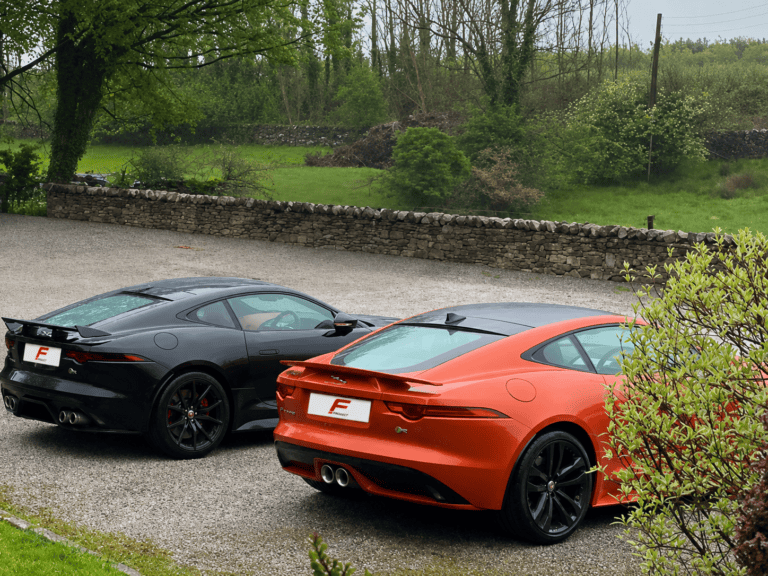
The Jaguar F-Type has always been about drama. It looks fast standing still, sounds fantastic and, depending on specification, can deliver anything from brisk performance to genuinely supercar-rivalling pace.
But for the performance enthusiast, the factory figures are only the beginning.
The F-Type’s engine range offers several different routes to more power. The 2.0-litre turbo responds well to ECU calibration, the 3.0-litre V6 has significant potential thanks to its supercharged architecture, while the 5.0-litre V8 provides an enormous platform for tuning.
The important question isn’t simply how much power can you make?
It’s how much power can you make while retaining a fast, reliable and usable F-Type?
There is no universal horsepower figure that can be labelled “safe”. Engine condition, mileage, fuel quality, ambient temperature, calibration quality and how the car is driven all matter. For this article, we’re therefore talking about sensible road-car targets, rather than absolute limits.
2.0-LITRE TURBO: 300BHP WITH PLENTY OF POTENTIAL
The four-cylinder F-Type is sometimes overlooked by enthusiasts, particularly when the 5.0-litre V8 is sitting further up the range.
That would be a mistake.
The 2.0-litre Ingenium turbo provides a very good foundation for tuning because forced induction gives the tuner considerably more scope than a naturally aspirated engine.
The standard P300 produces around 300bhp, and a quality ECU calibration is the obvious place to start.
ECU Tuning
A sensible Stage 1 calibration can take the engine into the 330–350bhp region, depending on the individual car, fuel and calibration.
That’s a substantial increase for a software-only modification and transforms the character of the four-cylinder F-Type.
Rather than simply increasing boost, a good calibration should optimise boost control, fuelling, ignition timing and throttle response to create a stronger torque curve throughout the rev range.
For a road car, around 340bhp is a very attractive target.
Going beyond that is possible, but the further the engine moves from its factory calibration, the more important supporting hardware and thermal management become.
Air Filters and Intake
A high-flow panel filter is an inexpensive supporting modification.
However, don’t expect a filter alone to produce huge gains. The factory intake is already capable of supplying the standard engine, so the real benefit comes when airflow demand is increased through tuning.
The goal is to reduce restriction without compromising intake temperatures.
Exhaust
A freer-flowing exhaust can further improve the turbocharged engine’s ability to move gases through the system.
A sports catalyst/downpipe and less restrictive exhaust can potentially offer additional gains, although emissions regulations, noise limits and road legality need to be considered.
The 2.0-litre’s tuning formula is therefore relatively straightforward:
ECU calibration + intake/filter + exhaust.
F Project Target
Standard: ~300bhp
Sensible road tune: 330–350bhp
F Project sweet spot: ~340bhp
For an everyday car, 340bhp represents a significant increase without turning the project into an exercise in chasing increasingly marginal gains.
3.0-LITRE V6: THE 400BHP SWEET SPOT
The supercharged 3.0-litre V6 is where F-Type tuning becomes particularly interesting.
The engine was offered in different states of tune, including approximately 340bhp in the base car and 380bhp in the V6 S.
Because the engine is already supercharged, there is much more potential than the naturally aspirated configuration.
And for the base 340bhp car, there is a particularly attractive target:
400bhp.
ECU Tuning
A good ECU calibration can take the 340bhp car towards 390–420bhp, depending on the tuner and supporting hardware.
Around 400bhp is what we would consider the sweet spot for a sensible road-going build.
It’s enough to produce a major difference in performance while still leaving sensible headroom.
The 380bhp V6 S can similarly be pushed into the 410–430bhp region with calibration and supporting modifications.
But there is another modification that changes the game.
THE SUPERCHARGER PULLEY
The supercharger pulley is one of the classic modifications for the F-Type’s 3.0-litre engine.
The principle is simple.
Fit a smaller pulley and the supercharger spins faster relative to engine speed. That allows it to generate more boost and move more air.
More air means the engine can make more power — provided the calibration, fuelling and supporting systems are designed around it.
A pulley should therefore never be considered independently from the ECU.
More boost without the correct calibration can create excessive cylinder pressure, heat and knock risk.
Pulley + ECU
Once a pulley is fitted and the car is correctly calibrated, the V6 can move into a much more serious performance bracket.
Depending on the hardware and calibration, 430–450bhp is a realistic target for a serious V6 build.
That makes the progression particularly attractive:
340bhp → ~400bhp → ~450bhp
The first stage is relatively straightforward.
The second requires more supporting hardware and attention to cooling and calibration.
At around 450bhp, you’re no longer simply optimising the factory car — you’re building a genuinely high-output V6.
AIRFLOW: DON’T FORGET THE INTAKE
Whether it’s the 2.0-litre or the supercharged V6, increasing power means increasing airflow.
A high-flow filter is the obvious starting point, but on a more aggressively tuned car the entire intake system becomes relevant.
The objective is to minimise restriction between the outside air and the engine while maintaining good intake temperatures.
This is particularly important on a supercharged engine because compressing air generates heat.
More boost doesn’t automatically equal more usable power if the intake temperature rises enough to cause the ECU to pull ignition timing.
That makes cool, consistent air just as important as maximum airflow.
EXHAUST SYSTEMS: LET IT BREATHE
The exhaust is the other side of the equation.
If you’re putting more air into the engine, you need to provide an efficient route for the exhaust gases to leave.
A properly designed sports exhaust can reduce restriction while giving the F-Type the more aggressive soundtrack its appearance arguably demands.
There is, however, a difference between a loud exhaust and a performance exhaust.
The objective is not simply to make the car noisier.
The objective is to improve gas flow while retaining appropriate exhaust velocity and back-pressure characteristics.
For a lightly tuned car, a cat-back system may be sufficient.
For more serious builds, sports catalysts and other flow improvements can become part of the package, subject to emissions and road-use requirements.
5.0-LITRE SUPERCHARGED V8: THE BIG ONE
Then we arrive at the engine that has become synonymous with the F-Type.
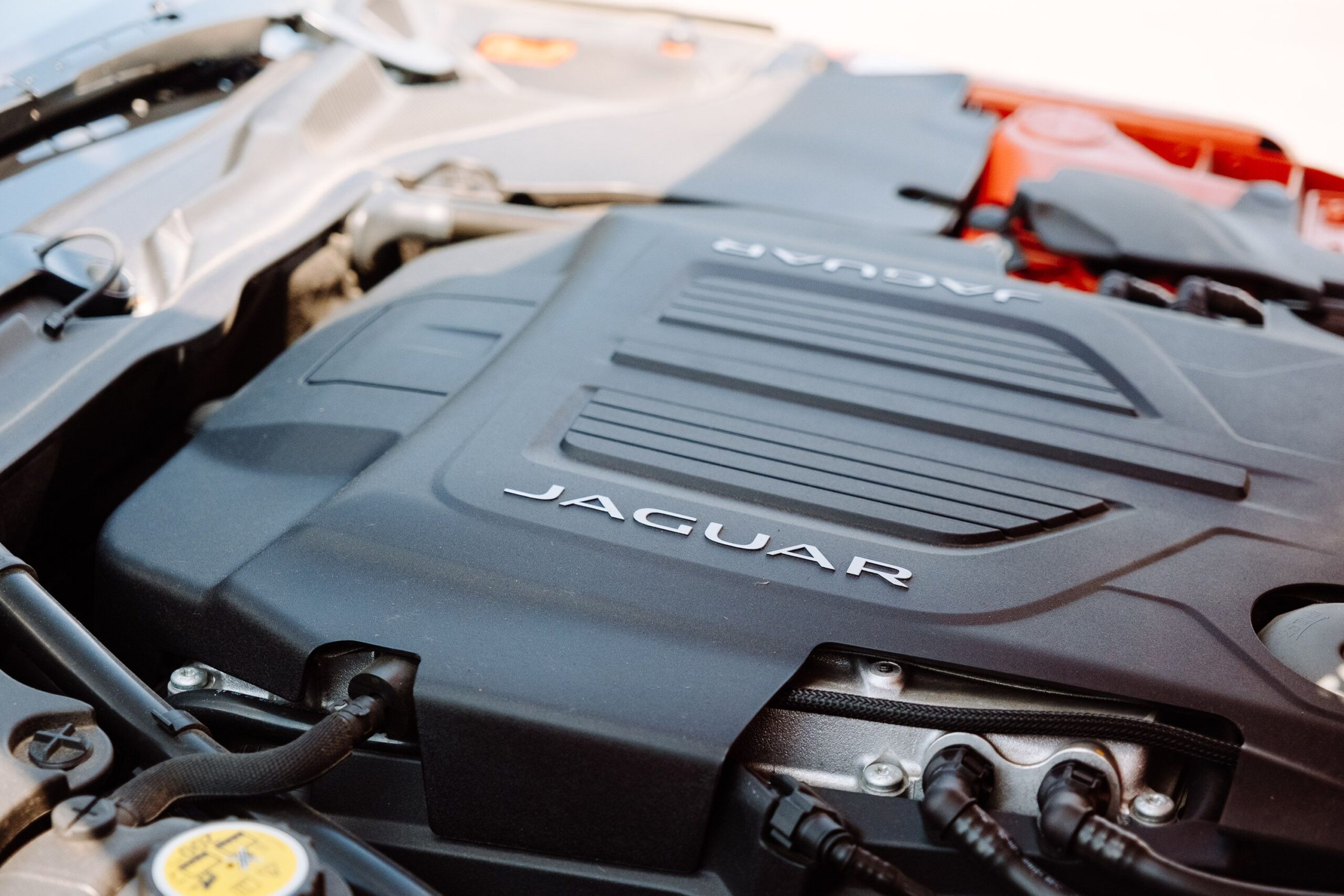
The 5.0-litre supercharged V8 is already a monster in standard form.
Depending on model and year, factory output ranges from the high-400bhp region to well over 550bhp.
But the engine’s supercharged architecture means there’s considerable room to increase output.
Here, the same basic modifications apply:
ECU + intake + exhaust + pulley.
Only the numbers get much bigger.
ECU TUNING THE V8
An ECU calibration is the natural first step.
For the lower-output V8 models, a good Stage 1 tune can move the car towards the 550–600bhp region, depending on the original specification.
On a higher-output model, the starting point is obviously different and the resulting gain will be smaller.
The key isn’t simply adding boost.
A good V8 calibration should balance boost, ignition timing, fuelling, throttle control and engine protection strategies.
The result should be a stronger engine throughout the rev range rather than simply a bigger peak figure.
SUPERCHARGER PULLEY: 600BHP AND BEYOND
Just as with the V6, the supercharger pulley is where the V8 starts to become considerably more serious.
A smaller pulley increases supercharger speed and therefore the potential for additional boost.
Combined with a suitable ECU calibration, intake and exhaust system, the V8 can comfortably move beyond the 600bhp barrier in appropriately specified builds.
And this is where we need to distinguish between possible and sensible.
A 600bhp F-Type is already an extremely fast road car.
For many owners, around 600bhp is the sweet spot.
It’s enough power to make the car feel dramatically different without necessarily pushing every component towards its limits.
Once you start chasing 650bhp, 700bhp and beyond, the project becomes increasingly dependent on supporting modifications.
THE SUPPORTING HARDWARE
At higher power levels, the ECU, pulley, intake and exhaust are only part of the story.
More boost produces more heat.
More power produces more drivetrain load.
More torque places greater demands on the gearbox, driveshafts and differential.
That’s why a serious F-Type build needs to consider the entire system.
Cooling becomes increasingly important, particularly on supercharged engines. Intake-air temperature should be monitored, and the car should be capable of maintaining its performance after repeated hard use rather than producing one impressive dyno pull.
The condition of the supercharger belt and associated hardware also becomes more important as pulley ratios change.
Spark plugs, fuelling capacity and ignition performance should be considered as part of the calibration rather than afterthoughts.
And, perhaps most importantly, the car needs to be mapped for the hardware actually fitted to it.
WHAT IS A SENSIBLE POWER TARGET?
For F Project, we’d divide the F-Type range into four broad tuning targets.
| Engine | Standard output | Sensible road target | Serious build |
|---|---|---|---|
| 2.0 Turbo | ~300bhp | 330–350bhp | 350bhp+ |
| 3.0 V6 340 | ~340bhp | 390–400bhp | 430–450bhp |
| 3.0 V6 S | ~380bhp | 410–430bhp | ~450bhp+ |
| 5.0 V8 | ~495–550+bhp | 550–600bhp | 600bhp+ |
These aren’t hard mechanical limits.
They’re sensible targets for a road-focused performance build.
The 3.0-litre provides perhaps the clearest example.
A 340bhp V6 taken to around 400bhp represents an excellent balance. The car gains a significant amount of performance without needing to pursue an extreme pulley and boost setup.
Take it towards 450bhp and the story changes.
The car can be extremely quick, but you’re now increasing the demands on the supercharger, cooling system, fuelling and drivetrain.
The same principle applies to the V8.
600bhp is a huge amount of power in an F-Type.
You can chase more, but ask yourself whether you actually need it.
POWER VS RELIABILITY
The temptation with tuning is always to chase the biggest possible number.
But a dyno sheet doesn’t tell the whole story.
A car making 450bhp for one pull isn’t necessarily a better tuned car than one making 420bhp consistently.
For a road-going F-Type, repeatability matters.
The engine needs to make its power when the weather is hot.
The intake temperatures need to remain controlled.
The ECU needs to have sufficient protection strategies.
The fuelling system needs to deliver consistently.
And the calibration needs to account for the fuel the owner is actually going to use.
This is why a conservative, properly developed calibration is worth considerably more than an aggressive generic map.
THE F PROJECT POWER LADDER
Ultimately, tuning an F-Type isn’t about turning every car into the most powerful version possible.
It’s about finding the point where the modifications work together.
For the 2.0-litre, that means making the most of the turbo with ECU tuning, airflow improvements and exhaust work, with approximately 340bhp being an excellent road-car target.
For the 3.0-litre V6, 400bhp is the magic number. It’s a substantial step beyond the 340bhp factory car and represents an excellent balance between performance and practicality.
For the V6 S, around 420bhp makes a compelling road car, while a pulley and bespoke calibration can take a serious build towards 450bhp.
And for the 5.0-litre V8, 600bhp is the figure that really changes the car. Beyond that, the supporting hardware becomes increasingly important and the project moves away from simple bolt-on tuning towards a complete performance build.
That’s ultimately what makes the F-Type such an interesting tuning platform.
There’s no single recipe.
You can build a relatively modest 340bhp four-cylinder, a perfectly balanced 400bhp V6, a 450bhp supercharged V6 or a 600bhp-plus V8.
And perhaps that’s the beauty of it.
The F-Type gives you the foundation. How far you take it is entirely up to you.